


 Danish Wadhwa
 Dr. Varun Bajaj, MD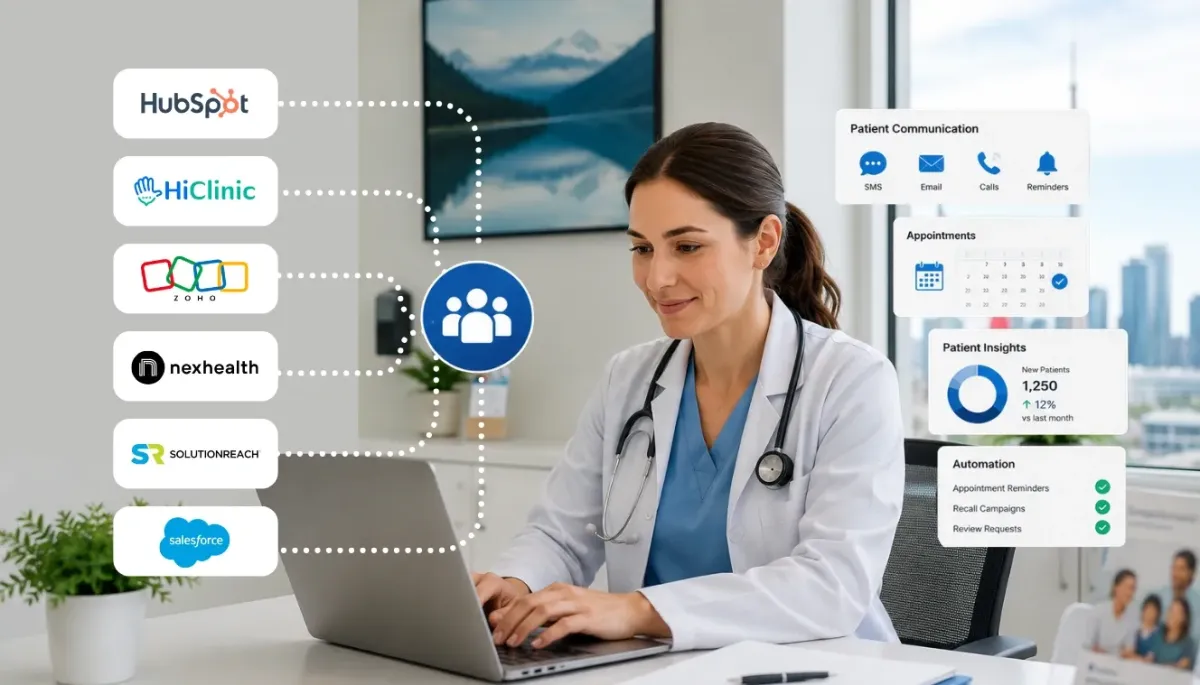
- Most clinics don’t lose patients because they provide poor care. They lose them because communication breaks down — a missed call goes unanswered, a follow-up never gets sent.
- Traditional CRM systems simply store patient data instead of helping clinics improve communication and retention.
- Clinics need software that manages patient relationships, automates follow-ups, reduces no-shows, improves retention, and streamlines front-desk operations.
- Six platforms compared: Salesforce, Zoho, HubSpot, NexHealth, Solutionreach, and HiClinic.
- Storing data is not the same as driving growth — communication automation is what moves the needle in 2026.
What is healthcare CRM software?
Healthcare CRM software helps providers manage patient interactions throughout the patient journey. Healthcare-specific CRMs are distinct from generic sales platforms because they are built around clinical workflows rather than sales pipelines.
These systems typically cover:
- Appointment scheduling
- Patient communication
- Follow-ups
- Reminders
- Retention campaigns
- Lead tracking
- Patient inquiries
Why do clinics need better patient management systems in 2026?
Patient expectations have changed. People now expect fast communication and convenient scheduling, and clinics are under pressure from staffing shortages, rising costs, and increased competition.
Manual workflows create bottlenecks around:
- Answering calls
- Scheduling appointments
- Confirming bookings
- Handling reschedules
- Following up with patients
What features should you look for in healthcare CRM software?
- Appointment scheduling. Patients should be able to book quickly without unnecessary friction.
- Automated reminders. Reduce no-shows with automated text, email, or call reminders.
- Patient recall tools. Bring inactive patients back for recurring visits and checkups.
- Communication tracking. Clinics should be able to track patient conversations across multiple channels.
- Workflow automation. Reduce repetitive administrative work for front-desk staff.
- Review generation. Strengthen the clinic’s reputation with consistent review requests.
- AI communication tools. Emerging technology that answers calls and messages automatically.
What are the best healthcare CRM platforms for patient management in 2026?
Salesforce — best for large healthcare organizations. Highly customizable for complex workflows, with strong analytics and enterprise integrations, but it is expensive, requires technical setup, and can feel overwhelming for smaller clinics. Best suited to hospitals and large networks.
Zoho — best for customizable workflows. An affordable option with flexible customization, though it requires manual setup and healthcare-specific configuration. Suited to smaller to mid-sized clinics.
HubSpot — best for patient acquisition. Strong on lead generation and marketing automation for growth-focused clinics, though it is less healthcare-specific and has limited retention features.
NexHealth — best for scheduling and patient engagement. Streamlines scheduling and communication with a modern user experience, but pricing may not fit smaller clinics and its operational tools are limited.
Solutionreach — best for patient communication. Focuses on reminders, recalls, and patient messaging, though it lacks broader growth tools and has a dated interface.
HiClinic — best for patient communication automation and retention. HiClinic distinguishes itself from traditional CRMs by helping clinics actively grow, automating communication across the full patient journey rather than just storing data.
HiClinic’s key capabilities:
- Recover missed calls with instant text responses
- Automate appointment reminders
- Bring inactive patients back through recalls
- Collect more reviews
- Reduce front desk workload
- Convert website visitors into appointments
Why do traditional healthcare CRMs often fall short?
Storing data is not the same as driving growth. Clinics using traditional CRMs still struggle with missed calls, slow response times, patient drop-offs, low review volume, and overworked front desk teams. These systems organize information but don’t always solve communication problems.
Why does HiClinic feel different?
HiClinic focuses on what many healthcare providers actually need: better communication, faster responses, higher retention, and less stress on staff. It helps clinics move beyond basic CRM functionality and build stronger patient relationships, aligning with growing demand for healthcare workflow automation software, healthcare CRM software, and digital healthcare solutions across Canada.
Key takeaways
- Effective CRM software does more than organize patient records — it helps clinics build stronger relationships with patients.
- Clinics need software that captures new patient opportunities, automates follow-ups, improves retention, strengthens reputation, and reduces operational bottlenecks.
- Traditional CRMs organize data; communication automation is what drives growth.
- The clinics that invest in better patient communication today will be the ones that grow faster in 2026.
Want to see how HiClinic would work for your clinic? Book a free demo and we will walk through your current workflow.